
Propane Saves Lake County and Cleveland Taxpayers 35% on Transit
Propane Saves Lake County and Cleveland Taxpayers 35% on Transit

- Propane Transit Bus Fleet: 87 vehicles
- Savings: 35% Lower Fuel Costs
- CO2 emission reduction – over 4.6 million lb CO2 / yr.
In 2015, Laketran, the regional transit authority serving Lake County and the eastern suburbs of Cleveland (about 230 square miles), began a serious evaluation of alternative fuels for its bus fleet. After comparing several options, the team landed on propane as the best fit for their operation. “We took some time and evaluated all the different options between propane, natural gas, and others,” said Ben Capelle, Laketran CEO, in an interview with the Ohio Propane Gas Association. “At the conclusion of that, propane was the fuel we wanted to use.”
In 2017, Laketran rolled out its first Ford E-450 propane buses. Today, Laketran operates 87 propane buses across the region. The propane bus fleet logged over two million miles and performed well in meeting transportation demands today.
Laketran’s Propane Fleet Is Saving Taxpayers Hundreds of Thousands
Since the Laketran decision to go with propane its quickly paid off. In 2025, Laketran saved $402,000 in fuel costs alone for their propane Ford E-450s compared to gasoline units.
“The primary reason was cost-savings,” Capelle said. “When you can save 35% and not do a whole lot different… You should make that decision because you want to save money. Sure, you use more of it than you do gasoline, but the cost of the propane fuel is so much less that it ends up being a net positive.”
Propane consistently costs less than gasoline or diesel and helps keep operating costs down for the communities Laketran serves. He states that maintenance stays straightforward, parts are familiar, and long-term costs are lower.
“It’s just a Ford engine with a different fuel tank, a different computer, and different fuel injectors,” Capelle explained. “So it’s really not that much different.”
“A propane gas engine is easier to work on than a diesel engine, so it’s easier to find mechanics,” Capelle added.

Click to Enlarge
“I love propane buses. The number one reason is they save the taxpayers 35%, and we don’t have to compromise on quality, safety, performance, or anything."
Ben Capelle, CEO Laketran
Cleaner Operations Across Lake and Cuyahoga Counties Using Propane
Before switching transit bus fuels, Laketran regularly received complaints about diesel exhaust from buses idling near buildings.
“We used to get complaints about diesel fumes blowing into businesses when a bus was sitting idle close by,” Capelle said. “We haven’t gotten any of those same complaints about propane just because it’s low-carbon emissions.”
Propane is the world’s third most common transportation fuel. Propane is a low-carbon, nontoxic alternative fuel and does not contaminate the air, soil, or groundwater (EPA), and is considered an alternative fuel under the Energy Policy Act of 1992. The EPA lists propane fuel as “low-emission,” emitting significantly fewer greenhouse gases and harmful pollutants than gasoline and diesel vehicles. Propane has been around for over 100 years, and 97% of it is made in the U.S.
Click to Enlarge
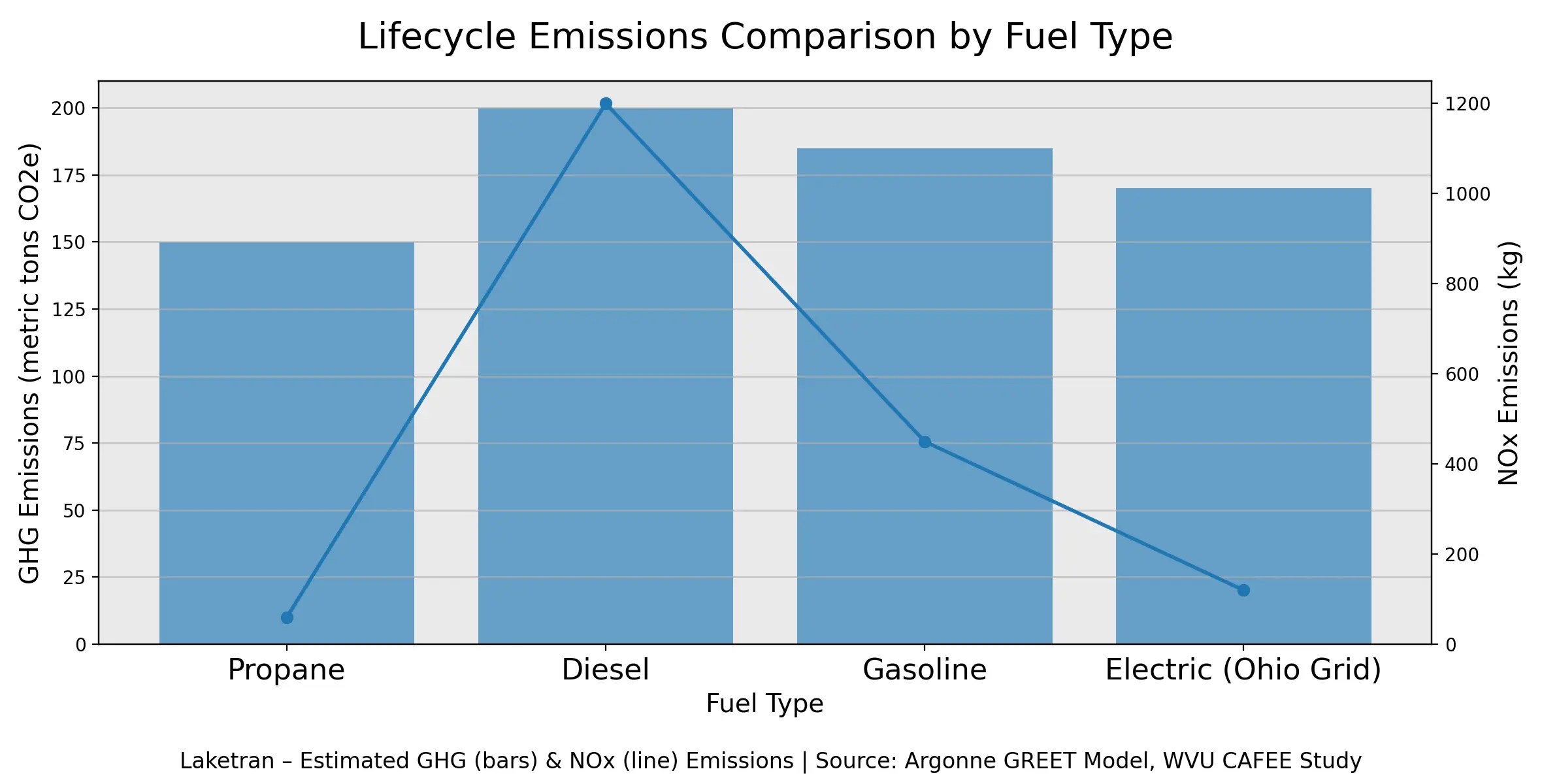
Capelle wanted to make a difference by offering cleaner rides throughout the city and rural bus routes. He reported his propane paratransits can cover anywhere between 100 to 400 miles a day; traveling just over 2 million miles in 2025, throughout Lake and Cuyahoga counties. Translates into tangible results: Laketran’s propane buses have reduced carbon dioxide emissions by more than 4.6 million pounds annually compared with gasoline-powered units. Propane also produces lower levels of nitrogen oxides, which helps improve local air quality and reduce smog.
Propane Powers Through Winters Along Lake Erie
With Lake County on Lake Erie, winters are tough, with added lake-effect cold, snow, and ice. When the agency began moving away from diesel, one of the first things drivers noticed was how much better the buses handled cold weather.
“Diesel engines struggle to heat up sometimes, and so they don’t always provide enough heat in the passenger compartment,” Capelle said.
Propane engines warm up faster, which means consistent heat for drivers and passengers even on the coldest Ohio mornings. In fact, Capelle joked that, early on, drivers began arguing over who would take the propane buses because they were noticeably warmer. In a region known for harsh winters, that kind of feedback speaks volumes.
Warmer buses help keep drivers comfortable, reduce cold-weather complaints from riders, and support on-time service when conditions are at their worst.
Safe for Passengers & Drivers
With over 30,000 propane-powered vehicles on Ohio roads, both fleet drivers and passengers prefer propane-powered transit vehicles for several reasons.
For instance, propane provides a remarkably quiet ride, enabling greater communication between drivers and passengers. Using propane doesn’t require PPE (Personal Protective Equipment) to fill a propane tank when using the Type K15 or Euro-style nozzle at the pump.
Propane fuel tanks are 20 times more puncture-resistant than those on gasoline and diesel units. They are made of carbon steel, in accordance with American Society of Mechanical Engineers standards, ensuring durability and reliability in transit.
Additionally, every on-site propane fueling station is equipped with a lock-off valve that automatically stops propane flow if a pressure drop is detected anywhere in the system, providing an extra layer of safety for transit fleets.
Easy-to-Install Propane Infrastructure
Switching fuels is a big decision for any fleet, especially when it involves new infrastructure. On paper, Laketran’s plan sounded ambitious. As Capelle explained, the long-term vision included “80-90 buses running on propane, a 30,000-gallon tank with multiple dispensers,” and a “system to be able to always take a full truck of fuel to reduce costs.”
In practice, the setup proved far simpler than expected.
“We discovered propane is shockingly less complicated than gasoline or diesel… I think all of us were a little surprised by this in a good way,” says Capelle.
“The actual fueling process is straightforward. There’s a tank, a pump, and a nozzle. It’s really not much different than fueling up your car,” he added.
For agencies considering switching to propane, Capelle emphasized preparation over perfection. Propane operates much like other fuels, so the learning curve is short. The key is to explain the ‘why’ to staff early—especially the cost savings and added benefits, such as warmer buses for drivers. “Change can always be hard, but if people understand the reason and they hear the savings you’ll get, in our case, the heat for the drivers, most people will come around.”
His biggest takeaway: plan your fueling infrastructure early, and the rest tends to fall into place.
$16,000 Propane Vehicle Rebates Available from the Ohio Propane Gas Association
Using propane can help save your transit’s budget. The Ohio Propane Gas Association offers fleets up to $16,000 to first-time propane users. The OPGA’s propane-fleet experts are available to help fleet directors, treasurers, and city officials transition to propane.
Learn more at: OhioAutogas.com/#funding